

Why child labor is decreasing (again)

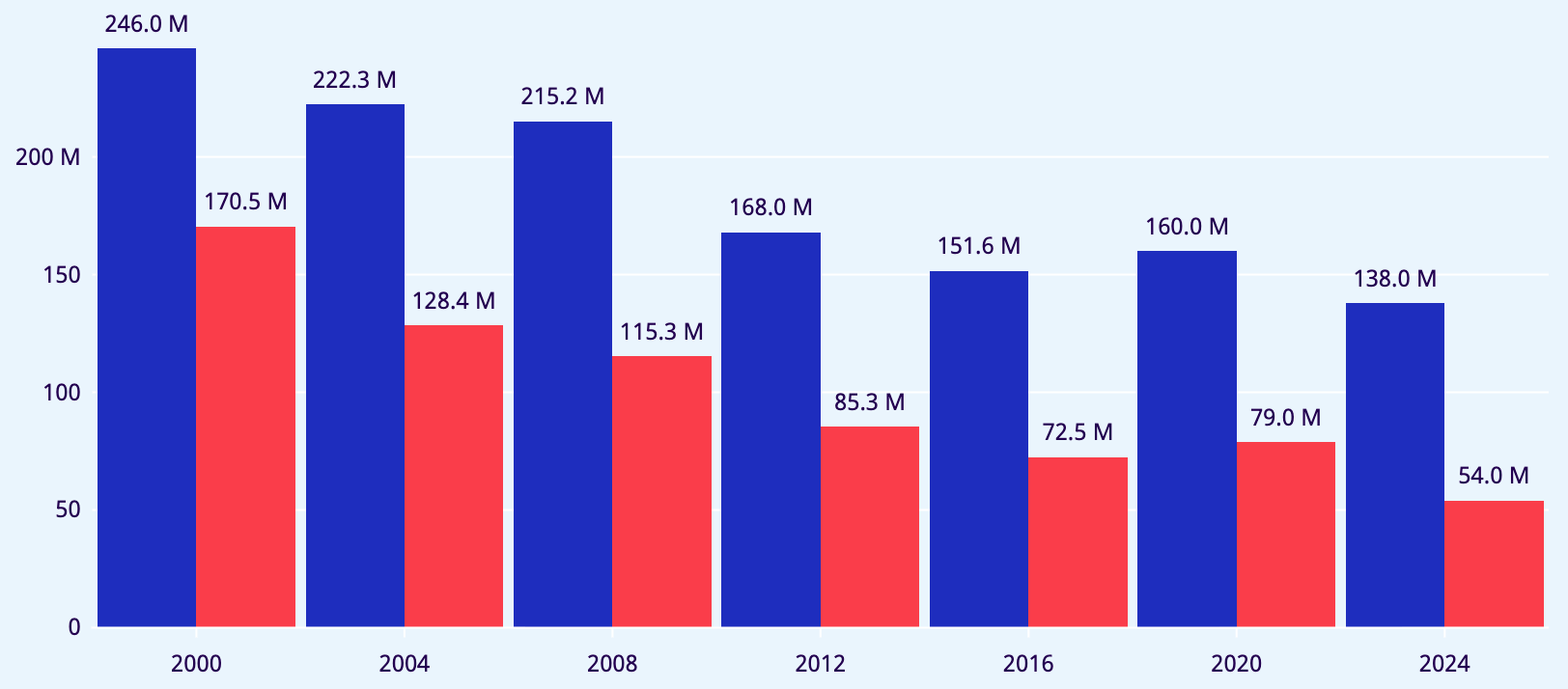
The above graph shows a decline, a few years of stagnation, and then a decline again to “138” in the year 2024.
That’s 138 million young people considered child laborers around the world, both a shockingly high number and also one that is decreasing again. In fact, since 2000, our world has added over 230 million children between the ages of 5 and 17, while the child labor count has fallen by 100 million (UNICEF, page 10). Today’s piece focuses on what child labor is and how it’s decreasing worldwide.
First, more context. The same graph above shows blue and red vertical bars, denoting the number of children overall in child labor and those in hazardous work, 54 million today. “Hazardous” is a broad term incorporating things like exposure to extreme temperatures, using dangerous tools, carrying heavy weights, working underground, and more. Two in every five child laborers work in these conditions. As can be expected, significant time in heavy industry or agriculture takes away school attendance. Nearly one-half of hazardous child laborers (page 44) and one-third of all child laborers aren’t in class, compared to just 8% of children not working.
Child labor looks different around the world. Overall, 9.6% of all children are child laborers (ILO, page 17). Across the focus regions of Sub-Saharan Africa, Asia and the Pacific, and Latin America and the Caribbean, all geographies have seen a decline in the child labor rate to today. Sub-Saharan Africa presents the biggest opportunity for change, with over 20% (or 86 million) children laboring.
The falling child labor rate is shaped by direct intervention and broader macro trends. In Asia, for instance, GDP tripled since 2000 to $17,000 per capita, in part meaning more family income for educational purposes, which helped the primary school completion rate climb past 94%. Broad-based “social protection” coverage (page 19) provides benefits like available health care, maternal and disability support, pensions and more. The greater a region scores in social protection, the less child labor is prevalent.
A set of policies was adopted in 2021 by the International Labour Conference to better define which of these benefits are most impactful. This was timely, as COVID-19 set back the linear decline in child labor. Some countries were able to successfully strengthen their child-based social safety net. South Africa, for instance, increased its Child Support Grant by R500 during the pandemic. Mongolia similarly adjusted up its Child Money Programme, doubling the monthly payment to MNT 100,000. In a simple procedural change, Guatemala and the Philippines “dropped the behavioral conditions assigned to their child benefits to remove impediments to benefit take-up” (page 24).
The work to end child labor is slow going. Social protections are not suddenly implemented only after a country has developed enough to have available cash on hand. Instead, they are adopted gradually with an understanding that they lead to better opportunities and better lives for citizens. Continuing the pace of progress, child labor could be brought to zero this century. Today, working children are still too common, but the data shows we’re back on the right track.
(12/28/25)
Note: Happy New Year! I hope the holidays have been a lovely time of rest and relaxation. In my thinking for next year, I’ve decided to make this entry of “Why” my last. There is a stack of books in my apartment collecting dust that I’d like to get to and am carving out more time for! As I did in my first post, I’ll plug again the wonderful book Factfulness as a exercise in hope that the world is getting better. Thank you for reading along this year.